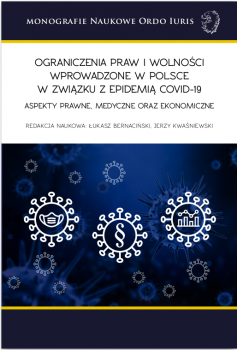
Restrictions on human rights and freedoms enacted in connection with the fight against
COVID-19 reminded the public that the Constitution is not a symbolic act, but a document
laying the foundations for the functioning of the state and a guarantee of the
inviolability of human freedoms and rights.
Due to the fact that the fight against COVID-19 was based on the limitation of the freedoms
and rights of individuals, it should be recalled which constitutional conditions
should be met by such restrictions enacted for the protection of public health. Article
31 (3) of the Polish Constitution sets out for state authorities the conditions and limits
of interference in the sphere of freedoms and rights of individuals. The former include
the requirement of the statutory form of introducing restrictions, which enforces the
transparency of the legislative process and ensures that the content of the regulation is
controlled by the representatives of the nation sitting in the parliament. Moreover, enacting
restrictions must be related to the protection of one of the values listed in the provision,
including public health. The limits of interference are determined by the principle
of proportionality and the prohibition of violating the essence of freedoms and rights.
The legislative activity of the COVID-19 epidemic has shown that the enacted law
raises constitutional doubts at the level of a formal premise. Enacting restrictions on
freedoms and rights in sub-statutory acts based on a questionable legal basis has led
to social unrest, undermined citizens’ trust in the state and the laws it enacted, and
weakened the actual impact of legal regulations. The latter should be assessed negatively
from the point of view of the usefulness imperative. The implementation of the
requirement of proportionality in the strict sense may also raise a number of doubts.
Finally, the practice of suspending the constitutional rights of an individual can be
assessed negatively. An example of such a practice may be a temporary, total ban on
certain types of economic activity or severe restrictions on the number of believers
who can participate in religious worship.

This work is licensed under a Creative Commons Attribution-ShareAlike 4.0 International License.