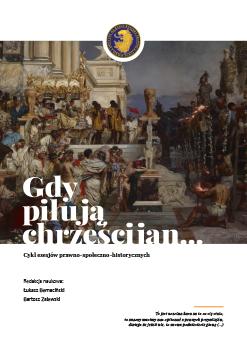
This essay by Bartosz Zalewski offers a legal and philosophical analysis of freedom of conscience and the right to conscientious objection within the Polish constitutional order, drawing on the Hobbesian metaphor of Leviathan as an all-powerful state bent on encroaching upon successive spheres of human freedom. The author argues that freedom of conscience is rooted directly in human dignity and constitutes — in light of Article 53(1) of the Polish Constitution and the case law of the Constitutional Tribunal — a veritable "right of rights."
The central portion of the essay is devoted to an analysis of the conscience clause in the medical professions. The author examines in detail the Constitutional Tribunal's judgment of October 7, 2015 (case no. K 12/14), which found unconstitutional those provisions of the Act on the Professions of Physician and Dentist that required a physician invoking the conscience clause to refer the patient to "real alternative options" for obtaining the given service and to perform the service in "other cases admitting of no delay." The Tribunal ruled unequivocally that the conscience clause does not create any privilege for the physician; rather, freedom of conscience — as a primary and inalienable category — must be respected regardless of whether statutory provisions confirm it. The author also raises constitutional concerns regarding analogous regulations applicable to nurses and midwives, and calls for the prompt statutory regulation of the conscience clause for pharmacists and other medical professionals, as well as for the repeal of Article 3(2) of the 1989 Act on Guarantees of Freedom of Conscience and Religion, a provision that dates from the period of authoritarian communist rule.
In the essay's concluding section, the author evaluates a legislative bill submitted by the Left parliamentary caucus that would abolish the conscience clause from the Act on the Professions of Physician and Dentist. The bill — silent on both the Constitutional Tribunal's 2015 judgment and the constitutionally protected freedom of conscience as such — is characterized as grounded in ignorance of the law and in direct conflict with the Polish Constitution. The author further notes that, even if enacted, the bill would not deprive physicians of the right to conscientious objection, which flows directly from the Constitution itself, and concludes with the maxim: ignorantia iuris nocet — ignorance of the law is harmful, including to the lawmaker.
Doktor nauk prawnych. Radca prawny. Absolwent studiów prawniczych na Wydziale Prawa i Administracji Uniwersytetu Marii Curie-Skłodowskiej. Pracownik naukowo-dydaktyczny w Katedrze Doktryn Polityczno-Prawnych i Prawa Rzymskiego UMCS. Ekspert Instytutu na rzecz Kultury Prawnej Ordo Iuris oraz Ośrodka Analiz Cegielskiego. Autor licznych publikacji z zakresu prawa rzymskiego oraz historii prawa.

This work is licensed under a Creative Commons Attribution-ShareAlike 4.0 International License.