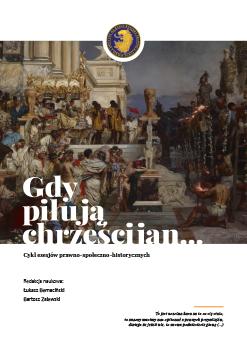
Keywords:
persecution of Christians, Catholic Church, religious law, religious freedom, Church history, anticlericalism, revolutionary legislation, religious discrimination, state–Church relations, protection of believers' rights
Published:July 13, 2023
The Polish model of Church-state relations, described as a friendly or coordinated separation, rests on the mutual autonomy of the state and the Church alongside cooperation for the benefit of the individual and the common good. The foundation of this model is Article 25 of the Constitution of the Republic of Poland and the Concordat concluded with the Holy See in 1993, which, as an international treaty ratified with prior statutory consent, takes precedence over acts of statutory rank. The Concordat guarantees, among other things, the freedom to carry out the Church's religious mission, the right to establish schools and universities, pastoral care in the military and penitentiary institutions, and the right to engage in charitable and missionary activity.
A segment of left-wing politicians advocates denouncing the Concordat and replacing the friendly separation model with a hostile one that would confine religious freedom strictly to the private sphere. This demand recurs regularly in public debate and has been voiced by, among others, Donald Tusk, Sławomir Nitras, and Maciej Konieczny — the last of whom, while calling for the Concordat's denunciation, was apparently unaware that doing so would require a constitutional amendment passed by a two-thirds majority in the Sejm.
The author argues that these demands echo the communist model of hostile separation enshrined in the Constitution of the Polish People's Republic, a document personally approved by Joseph Stalin. While certain aspects of the state's relations with religious communities do require adjustment — particularly in financial matters — any fundamental change to that framework cannot be effected by the unilateral decision of a group of politicians, but must follow the constitutional amendment procedure laid down in the Constitution.
Łukasz Bernaciński, Ordo Iuris Institute
Doktor nauk prawnych. Wiceprezes Ośrodka Analiz Prawnych, Gospodarczych i Społecznych im. Hipolita Cegielskiego, członek zarządów Fundacji Instytut na rzecz Kultury Prawnej Ordo Iuris oraz Fundacji Centrum Wspierania Inicjatyw dla Życia i Rodziny. Zastępca redaktora naczelnego czasopisma naukowego „Kultura Prawna”. Czterokrotny stypendysta stypendium Rektora Uniwersytetu Łódzkiego. Dysertację doktorską pt. Obywatelski odpis podatkowy jako potencjalne źródło finansowania kościołów i innych związków wyznaniowych w Polsce. Perspektywa prawnowyznaniowa obronił z jednogłośnym wyróżnieniem. Prelegent ponad dwudziestu międzynarodowych i ogólnopolskich konferencji naukowych. Autor lub współautor ponad dwudziestu publikacji naukowych, w tym trzech monografii, a także kilkunastu projektów ustaw, ponad sześćdziesięciu analiz, opinii prawnych, raportów i poradników oraz ponad pięćdziesięciu komentarzy popularnonaukowych. Absolwent programów liderskich z zakresu prawa, zarządzania oraz funkcjonowania organizacji pozarządowych. W pracy naukowo-badawczej koncentruje się na prawie wyznaniowym, prawie konstytucyjnym i prawach człowieka.
Copyright (c) 2023 Ordo Iuris Institute for Legal Culture - Scientific Press