Keywords:
persecution of Christians, Catholic Church, religious law, religious freedom, Church history, anticlericalism, revolutionary legislation, religious discrimination, state–Church relations, protection of believers' rights
Published:July 13, 2023
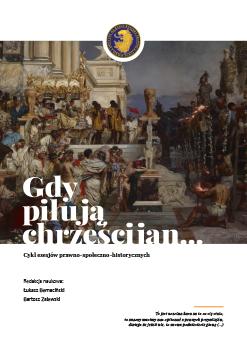
The essay examines the debate surrounding proposals to repeal Article 196 of the Polish Penal Code, which criminalizes offending religious feelings. The author argues that despite assumptions about secularization, the modern world continues to experience religious persecution, including a growing hostility toward Christians in Poland. In this context, calls for decriminalization frequently appear in public discourse, often justified by appeals to freedom of speech and the principle of state neutrality.
The author maintains that freedom of conscience and religion is a fundamental right rooted in human dignity, encompassing both internal convictions and their external expression. The protection of religious feelings is presented as an integral component of this freedom, as confirmed by the jurisprudence of the Constitutional Tribunal and international legal standards. Although freedom of expression may conflict with religious protection, its limitations are considered legitimate when they serve to protect the rights of others and maintain public order.
In the final part, the author points to the rising number of hostile acts against Christians and argues that removing criminal sanctions for offending religious feelings could intensify this trend. Decriminalization would, in his view, lower the standard of protection for religious freedom and signal tolerance for aggression and violations of believers’ dignity. The essay concludes that maintaining criminal-law protection is necessary to safeguard social order and ensure effective protection of fundamental human rights.
Bartosz Zalewski, Maria Curie-Skłodowska University
Doktor nauk prawnych. Radca prawny. Absolwent studiów prawniczych na Wydziale Prawa i Administracji Uniwersytetu Marii Curie-Skłodowskiej. Pracownik naukowo-dydaktyczny w Katedrze Doktryn Polityczno-Prawnych i Prawa Rzymskiego UMCS. Ekspert Instytutu na rzecz Kultury Prawnej Ordo Iuris oraz Ośrodka Analiz Cegielskiego. Autor licznych publikacji z zakresu prawa rzymskiego oraz historii prawa.
Copyright (c) 2023 Ordo Iuris Institute for Legal Culture - Scientific Press